



Maktabatul-Irshad Publications
-
Explanation of Riyad us- Saaliheen: Chapter on Prohibtion of Arrogance & Self-Conciet
Hadith $6.99Arrogance is of two types: Arrogance toward the truth and arrogance toward people. The Prophet (sallahu alayhi wassallam) clarified both in his statement, “Arrogance is to regret the truth and belittle the people”
The meaning behind the statement, “Reject the Truth” is to discard it, be averse to it, and to deny it, and the meaning behind the statement “Belittle the People” is to disparage and disdain them, and deem people to be of no worth, seeing oneself above them.
It was said to one man, ‘What do you think of the people?” He said, “I don’t view them in any way except as flies.” So it is said to him, “Indeed they don’t think of you in any was except the same.”
-
Explanation of the Hadith: When Allah wants good for a person He bestows on him Fiqh of the Religion
Hadith, Learning-Studying $9.99The word, “good” is mentioned in an indefinite form (in Arabic) to attach a level of importance and clarify the abundance of good to whomever Allāh bestows Fiqh of the religion which by it is a means for one’s victory and success. The servant finding happiness in having Fiqh of the religion, devoting oneself to it, regularly attending the sittings of knowledge, being delighted with reading the books from the people of knowledge, also studying and memorizing is among the signs of good for the servant.
The servant should set aside a portion of his day for seeking knowledge. An avenue in which he acquires knowledge is that he doesn’t let a day pass by without obtaining it. Doing this should be among the objectives that the Muslim strives for daily and is serious about acquiring beneficial knowledge. Rather this is the most significant objective the Muslim seeks and strives for its obtainment.
-
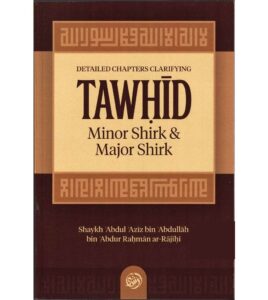
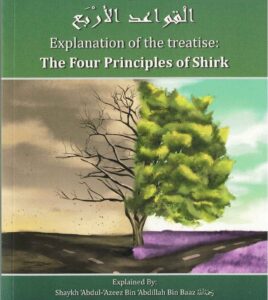
Explanation of the Treatise Four Principles of Shirk
Aqeedah-Creed $5.99When the believer becomes aware that when Shirk is mixed with Tawheed it becomes corrupted just like when al-hadath corrupts purification then he should become aware that it is necessary to learn Tawheed and Shirk as it really is, so he would not fall into Shirk.
Because Tawheed by definition is the religion of Allah, it is Islam, it is the guidance. So when a person does any type of Shirk this nullifies his Islam, this nullifies his religion.
-
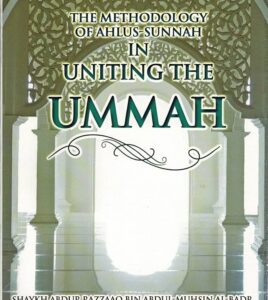
The Methodology of Ahlus-Sunnah in Unifying the Ummah
General, Minhaj-Methodology $7.99This is the command of Allaah, the Blessed and High, and His Legislation for His Prophets and the Messengers of Strong Will; establishment of the religion and not dividing in it. This verse contains the most beneficial solution and the safest remedy to quell the differing and to set in order the disarray.
Establishment of the religion is by way of clinging to their religion which Allaah, the Blessed and High, has commanded them with, and preserving it. There is no solution other than this and there is no remedy except it. In establishing the religion, there lies cutting off of the splitting which the people fall into. This is by way of completely returning to the religion.
-
The Obligation of Implementing the Sunnah & Deeming Whoever Rejects it of Disbelief
Aqeedah-Creed, Minhaj-Methodology $9.99In this regard, many verses indicate the obligation of obeying the Prophet and adhering to his Sunnah. Also, previous evidence indicated the obligation of adhering to the Book of Allāh, sticking to it, and complying with his orders and abstaining from its prohibitions. These are two relevant fundamentals in which whoever denies one of them denies the other. This is considered an act of disbelief and misguidance which takes one outside the fold of Islām as agreed by all the scholars.
The ahādīth of the Prophet (May Allah raise his rank and grant him peace) indicated the obligation of obeying the Messenger of Allāh (May Allah raise his rank and grant him peace), following his Sunnah and refraining from disobeying him. All of this is relative to the people of his era as well as those to come. It is related by Al-Bukhārī and Muslim on the authority of Abū Hurayrah (May Allah be pleased with him) that the Prophet (May Allah raise his rank and grant him peace) said:
“Whosoever obeys me, obeys Allāh; and he who disobeys me disobeys Allāh.”
(267) 428-1723